

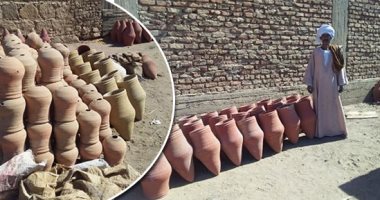
The handicrafts made by some professionals and primitive workshops in Aswan received a great turnout, whether in terms of local consumption or in terms of tourists, or visitors to the governorate who are keen to buy them as souvenirs.
In a serious step to preserve these crafts from extinction, the Aswan Civilization and Heritage Center at Aswan University has documented these various products that are produced by a small number of people in some villages and hamlets of Aswan, where these producers market their exhibits directly, whether in the local markets or on the sidelines. Holding events and festivals in Aswan.
First, Dr. Radwan Abdel-Radi, Assistant Professor of Egyptian Archeology at the Faculty of Archeology at Aswan University, and director of the Aswan Civilization and Heritage Center says to “The Seventh Day” that the Aswan Civilization and Heritage Center is within the framework of its keenness to stand by the owners of crafts and heritage industries in Aswan, who suffer from the inability to purchase the material the raw materials for their industry, besides their inability to sell and market their crafts, whether internally or externally, as they become a prey in the mouth of the exporters of heritage crafts who take advantage of their poor living conditions, by providing them with raw materials and then buying their handicraft products at low prices and then selling them again internally and externally at high prices in the local markets or global.
Dr. Radwan Abdel-Radi added that the Civilization Center documented the pottery industry in Edfu Center, north of Aswan, as part of the documentation plan of the Aswan Civilization and Heritage Center at Aswan University for the natural, tangible, and intangible cultural heritage of Aswan Governorate. Sixty years old he is a sheik and a master skilled in the craft of pottery, the ancient and important traditional handicraft.
Al-Fakharani was born and raised in the village of Treat Nasser in the city of Esna and learned this handicraft inherited in his family since he was six years old from his father, Hajj Saadi, in Esna, then he moved to the city of Edfu with his family in the Al-Hajir area in western Edfu, which is the place where we met him where he and his family live.
”Al-Haji Abdul Saadi’‘ learned the craft of pottery out of his desire and love for it without the guidance of his father or any person from his family. In this regard, Al-Rais Abdo “Al-Hajj Abdo Saadi” says that the craft of pottery is an ancient craft inherited from the time of the ancient Egyptians and continues to this day, due to its importance and many benefits, as it helps people to put water in pots such as jars, bowls, and food in casseroles, pans and pottery dishes because they are completely healthy and maintains human health and safety because it is made of materials from nature. Doctors also advise using the zeir water, where the burnt pottery filters and purifies the water as a natural filter without poisoning or pollution, as well as the utensils in which food is placed.
”Al-Hajj Abdo ”also adds that people buy drinking water to drink it at home, and they put them in the streets for passersby to drink from, and it is what people call a way of reward, as well as ongoing charity for the souls of the deceased relatives of the people. This is exactly the same as the fountain facilities in Islamic civilization, from which there are many examples remaining in Cairo so far.
However, ”Al-Hajj Abdo ” says that the problems of the pottery craft are that there are some of the problems that it faces in this manufacture, including the lack of good raw material needed for the manufacture of pottery, which is the clay of running agricultural drains and not stagnant water, soft, sticky, very black, but it must be pure of any impurities such as gravel and weeds even any defect or error while processing does not occur and affect the safety and quality of the final product; this type of clay is not much available only after deep cleaning to the agricultural banks.
”Al-Hajj Abdo” continued that one of the problems facing the pottery craft is the lack of interest of the youth of the current generation to understand and master the craft of pottery, despite the presence of young assistants for it in the stages of pottery making, but none of the youth tries to understand this craft to be proficient in it.
He adds that the craft of pottery is a desire and a hobby for those who want to master it and learn it, and it does not conflict with the education journey of the student of knowledge, as it is absolutely necessary to love and adore this craft first, then the great desire to learn it, and one of the problems facing the craft of pottery Young people leave for easier and faster-earning professions that do not require great physical effort, such as driving cars or working on a tuk-tuk.
One of the problems facing the pottery craft is the use of modern utensils of aluminum and other manufactured materials, and the non-use of pottery utensils for food and drink despite knowing the danger of using metal utensils to human health and that crockery is the safest for human health and safety.
”Al-Hajj Abdo” said that in the past there were about fifty or sixty people who practiced the craft of pottery in Edfu, but now they count on the fingers, also mentioned that the demand for his products is very high, and he earns from this profession well, and there are no problems in selling and disposing of goods. Where there is a great demand for it from the people and traders from Esna and Edfu.
On the other hand, ”Ahmed Gad” from the people says that these producers and owners of handicrafts need support so that they can continue to produce these masterpieces of crafts and handicrafts, especially that they have a large audience, as well as those who visit festivals, trips, and tourist groups accept to buy them.
” Hassan Al-Sheikh” from the people says that he calls for the expansion of art galleries for exhibitions and handicrafts, as well as the transformation of small workshops into factories for the production of pottery and ceramics, as these industries provide job opportunities for much-unemployed youth.
Aswan University had established the Aswan Civilization and Heritage Center, based on the Aswan Governorate’s long and honorable history. Aswan Governorate is also characterized by a unique location, a great position in the history of humanity, and the elements of ancient material and human genius.
The center came to light with the approval of the Supreme Council of Universities No. (417) on December 4, 2017, to establish the center. And the decision of the President of Aswan University to form the center’s board of directors on January 1, 2019.
The Center for Aswan Civilization and Heritage at Aswan University participates strongly in the events related to the cultural heritage that is held in Aswan, such as (the celebration of the Aswan Governorate National Day, the Tourism Festival, the Nuba celebrations, and the sun perpendicular to the Temple of Ramses II in Abu Simbel) through media support.
The Cultural Heritage Center within Aswan University directly reflects the university’s interest in assuming its responsibilities towards the community in Aswan Governorate in preserving Aswan heritage, and in a strong response to the obstacles and problems facing the heritage within the governorate, and even working on developing and marketing the components of the cultural heritage in the governorate, and exploiting those heritage components in activating non-traditional tourism patterns, which is directly reflected in the development of society.
It is also possible to exploit the unique and distinctive cultural heritage of Aswan as an important and effective tool for sustainable development within the governorate and to raise the economic and social level of the people of the governorate.
It is worth mentioning that ”Aswan Civilization and Heritage Center” is representative and reflective of the interest of Aswan University in assuming its responsibilities towards the society in preserving the tangible and intangible Aswan heritage and in a strong response to the obstacles and problems it faces and also working on good management, development, and marketing of the diverse and distinguished Aswan cultural heritage components to be used in activating non-traditional tourism patterns, and working on exploiting the cultural heritage in the governorate as an important and effective tool for sustainable development and developing the local community culturally, socially and economically.
The objectives of the Aswan Civilization and Heritage Center are to document the natural, tangible, and intangible cultural heritage of Aswan Governorate, good management of the heritage components in the governorate, and marketing for it with high efficiency, in addition to documenting cultural and scientific ties with other universities and scientific bodies at the local, Arab and international levels, and raising the level of cultural and heritage awareness for Aswan University students.
Introducing the components of the distinguished and diverse cultural heritage that Aswan Governorate enjoys, and holding training and teaching courses in the field of cultural heritage to train the target groups from Aswan University students or from outside, whether working in the ministries of culture, antiquities, environment, tourism and other related bodies and common interest.
