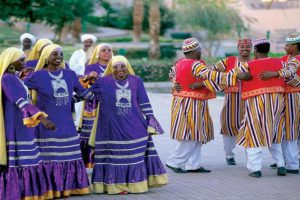
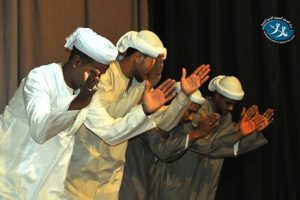
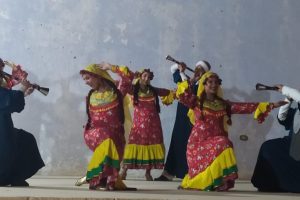
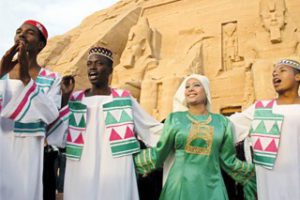
Aswan (Nubian) folk or folkloric dance arts:
A language that does not die, especially within the Nubian society, so we find that the Nubian people have always had the ability to overcome the difficulties and laws that threaten their existence by singing and dancing, so we find them dancing even to death. It has a special dance that has a standard form for wedding dances.
They know how to dance for the tragedies, chant in sorrows, or clap their hands in tribulations,to prevent danger; They also know how to hit the ground with their steady feet to create rhythms that symbolize the spirit of Glory, pride, steadfastness and challenge.
The dance was also associated with the season of planting and harvesting, whereas the “arageid” dance is considered the most famous dance in Nuba, and the “Aragide” dance was closely linked to the Henna night and the Nubian weddings used in it
A musical instrument similar to a drum that accompanies the singing of singers at Nubian weddings. As for the method of using it that machine, so we beat its users with the hand on the “aragids”. Nubians do not accept the presence of a dancer specialized in dancing in their weddings, they do not like it; Nubian dance is a group dance by nature, Men and women of all ages participate in it, and dancing, melodies and singing in Nuba are not
just a heritage and culture, but it’s a method of life, human behavior, and a daily habit more like to Rituals of the Nubians
Nubian Rhythms:
The basic rhythms in traditional Nubian music include: (Kumbash), (Kitchad), and ) Allah Lei Li), which is sometimes called (Kenzi Rhythm), and Olen Argid, meaning the dance of the palm, in addition to other rhythms such as (Ski). , and (hal) and (fizzy).
Nubian music knew a number of musical instruments, the oldest of which was called (the whistle), which is played by blowing, then the one-stringed rebab, then the tambour (Krei Okiser), which is a stringed instrument, and then the oud instrument that was introduced to music in the century In the twenties, Arab instruments such as the keyboard and guitar were also introduced, and thus the music became hybrid, which the author indicates to him that it was a factor in the spread of the Nubian song and music.
The other form of the Nubian arts is the Nubian singing, where the Nubians used to speak in the past in the ancient Egyptian language, then the Marian language in relation to the state (Meroe), and they also borrowed some Coptic letters and added letters from the demotic language to them, so the Nubian language became a reading and writing language, And they added three letters to it, which are: (Chai – Naqai – Nagai), so that the number of letters in the Nubian language became (24) letters, and thus the dialects of the people of Nubia multiplied (Treasures, Fadija, Arabs, Mohs and Sukkot), and therefore the Nubians speak and sing in three dialects, which are: (Kinzi Al-Fadijia and Al-Danglawiya), in addition to Arabic, as the author points out that throughout the history of Nubia, the singing of its people varied between singing the tambour and the songs of the tar.
And that one of the characteristics of Nubian singing is that it depends on the participation of the chorus consisting of women, children and men, and it consists of one melodic basic line, but at the same time it is performed through multiple vocal areas, and most of the Nubian singing is accompanied by dances and palm clicks, which are characterized by the synopsis, strokes and overlapping Rhythmic, which made the Nubian community able to bring out to the world a number of the most famous artists whose singing is distinguished by the distinctive Nubian color.
Specialist historians mention that ancient Nubia had an artistic style for each of its folk arts, and this art represents the summary of every stage of development of a region of Nubia during the historical periods during which different cultures successively affected the people of Nubia and its people, and where three population groups were distinguished among the people of Nubia. Al-Kunuz, Al-Fadeha, and Al-Arab, which made each population group of these three groups have distinctive characteristics for their school of art.
Wasatani dance “Sheila”
It is performed after the arrival of the procession of the sheila or the bridging of money to the house of the bride’s family, and only women dance it with beating tambourines and singing, lining up in a semi-circle and intertwining their hands and moving forward and backward slowly, with the movement of the middle and progress in a slight bow, with the hands raised intertwined and then lowered, and one of them enters The girls lead the dance faster in a group of women.
Arajide performance
The performance of the arias is accompanied by singing, vocal rhythm, and the beating of tambourines. The formations are characterized by a regular step, starting from the day the henna dyes are dyed. On the wedding night, the singers advance to the middle, and the men strike the tambourines. The women line up in front of them, and they are formed in the form of a square or a circle. Regular uniform to the right, then pulling the body on it and pulling the left foot while shaking the body forward, then returning the left foot and the body on it while pulling the right foot, and the hands are intertwined at the arm or forearms, and some friends of the groom dance alternately inside the circle.
Free dance
It is called the quail dance, and it is performed as part of the henna and wedding ceremonies. A group of young men gather in a semicircle and a group of girls in the other half. Two girls dance in the semicircle with very fast steps. They go out and others enter. The dance is accompanied by a song of the same name.
Balaga dance
Or the Dalwa dance, which is similar to the Frey dance, but it is slower and symbolizes the bride. It is accompanied by a ballad song praising the bride.
palm dance (Al-Holi Al-Holi)
The palm dance at the treasures has more than one method, including the holly holly, in which young men and men line up in the form of a square performing unified steps, and among them are the singers who perform songs and beat the tambourine, and the palm beating is intensified, and three tambourines and two big tambourines stand to perform songs with beating on The tambourines stand in the middle, and the drummer sits on the side, and the men and women circle around them at the edge of the circle, and four of the tambourines jump forward and clap to the rhythms of the drums and tambourines.
Among the groom’s relatives, a girl stands participating in the dance while wearing a veil on her face.
Palm Dance (Al-Trbala – Al-Kru)
A circle is formed of men clapping, and the circle turns into a rectangle, and a percussionist sits at one of its corners, and next to him is a sword, a spear, and a darqa.
The father of the groom, who performs the dance, begins by raising his sword and shaking it in the air, repeating words praising lineage and lineage, the women ululate behind the ring, and the men emit grunts as an expression of joy and pride, then he takes the shield and begins to show the dance, jumping to the end of the rectangle and returns to where it started, and puts the shield and sword in their place so that others can take them And whenever a performer came out after performing the dance, the father of the groom entered the middle of the circle and fired shots in the air to salute the performer.