

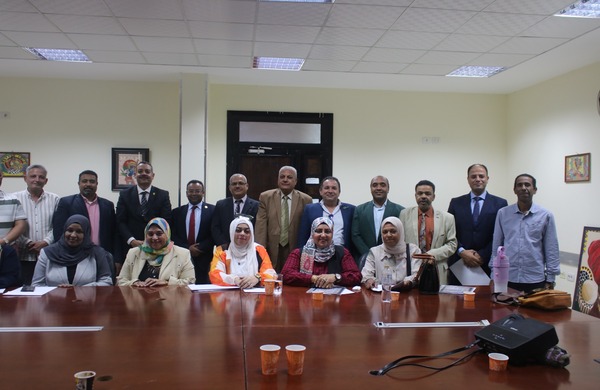
In line with Aswan University’s commitment to developing the capabilities of its academic staff and preparing them to assume leadership positions based on scientific and professional principles, and as part of its ongoing efforts to build university leaders capable of keeping pace with the requirements of institutional development, the university organized a University Leadership Preparation Program for Candidates for the Position of Dean, in cooperation with the Leadership Development Institute. The program was held from August 7 to 10, with the participation of a distinguished group of leaders, experts, and specialists in management, leadership, law, and strategic planning.
The program was held under the patronage of Prof. Mohamed Abdel Aziz Mehallal Orabi, President of Aswan University, and Dr. Karim Hammam, Advisor to the Minister of Higher Education and Scientific Research and Director of the Leadership Development Institute, and under the supervision of Dr. Abdel Moneim El-Gilany, Director of Faculty and Leadership Development Center at Aswan University.
In this context, Prof. Mohamed Abdel Aziz Mehallal, Acting President of Aswan University, participated in the program’s activities, addressing the theme of institutional development across the sectors of education and student affairs, postgraduate studies, community service and environment development, and international relations. He highlighted the importance of achieving integration among the various sectors of university operations and linking executive plans to the university’s strategic vision.
The President of Aswan University emphasized that university leadership has become a responsibility requiring an integrated vision that goes beyond traditional management. He explained that preparing candidates for leadership positions is one of the fundamental pillars for ensuring sustainable development within university institutions.
He pointed out that the university places great emphasis on building the capacities of Academic staff and preparing them to assume leadership responsibilities, enabling them to manage Faculties efficiently and achieve a balance among the quality of education, scientific research, and community service. He also stressed the importance of strengthening the university’s ability to keep pace with the rapidly changing higher education system.
He further explained that investing in people and qualified leaders is the most influential investment in the future of institutions, emphasizing the importance of university leaders possessing the tools for planning, decision-making, team management, as well as the ability to address challenges and crises efficiently and with institutional awareness.
For his part, Dr. Abdel Moneim El-Gilany, Director of Faculty and Leadership Development Center at Aswan University, explained that organizing the program comes within the framework of the university’s strategy to develop academic cadres and build a second tier of qualified university leaders. He noted that specialized training programs represent a fundamental tool for equipping candidates for leadership positions with the knowledge and skills required by the nature of administrative and academic work within universities.
He confirmed that the program was designed to provide comprehensive content combining theoretical knowledge with practical applications, helping participants understand the roles and responsibilities of university leaders and deal with the various areas falling within the scope of a faculty dean’s responsibilities—from planning and institutional development to financial and legal administration, as well as crisis and risk management and combating corruption.
He added that leadership preparation is not limited to providing knowledge; rather, it aims to develop leadership personalities capable of making decisions, assuming responsibility, and transforming plans into tangible outcomes. This is an approach that Aswan University is committed to promoting through its ongoing programs for developing the capacities of Academic staff and university leaders.
The training program included a number of specialized themes. Dr. Karim Hammam, Advisor to the Minister of Higher Education and Scientific Research and Director of the Leadership Development Institute, addressed the topic of University Leadership Skills, focusing on leadership and supervisory skills, team management, and the importance of creating a collaborative work environment and achieving objectives.
Counselor Atef Omar, Advisor to the Minister of Higher Education and Scientific Research, addressed the legal aspects of universities, enhancing participants’ awareness of the rules and legal frameworks governing university work.
Dr. Mohamed Abdel Fattah, Deputy Director of the Leadership Development Institute, addressed strategic planning, presenting the principles of developing strategic plans, mechanisms for their implementation, and methods for measuring their outcomes.
Dr. Ahmed Al-Dahshan, Vice Dean of the Faculty of Law at Zagazig University, addressed the financial and administrative aspects of universities, contributing to improving the efficiency of administrative practices and promoting the optimal use of resources.
Dr. Hanan Kamal, Coordinator of the Anti-Corruption Committee at Capital University, addressed several important topics, including national issues, combating corruption, and crisis and risk management, with a focus on strengthening the values of integrity, transparency, and good governance in institutional work.
At the conclusion of the program, certificates of completion were distributed to the participants, in attendance of Prof. Mohamed Abdel Aziz Orabi, President of Aswan University. The event underscored the importance of continuing cooperation between Aswan University and the Leadership Development Institute in implementing training programs aimed at enhancing the capabilities of Academic staff and preparing qualified cadres to assume leadership responsibilities, thereby supporting the university’s ongoing institutional development.
